PwC found the value gap. It sits in the execution system.
AtlanticM&A6 min read
PwC published its 2026 M&A Integration Survey on 29 September. It asked 530 C-suite executives and senior dealmakers, at companies with $1 billion or more in revenue, about deals they had worked on in the past three years. Only about one in three said they had fully achieved their deal thesis objectives.
PwC's diagnosis is that the value gap is a decision gap: the distance between the deal thesis and the explicit, owned choices needed to make it real. I agree. When I integrated nine acquisitions into one company across three continents, the deals that went well were the ones where we decided early what to change, what to protect and who owned each result. The ones that drifted were the ones where those decisions waited.
The number that matters most
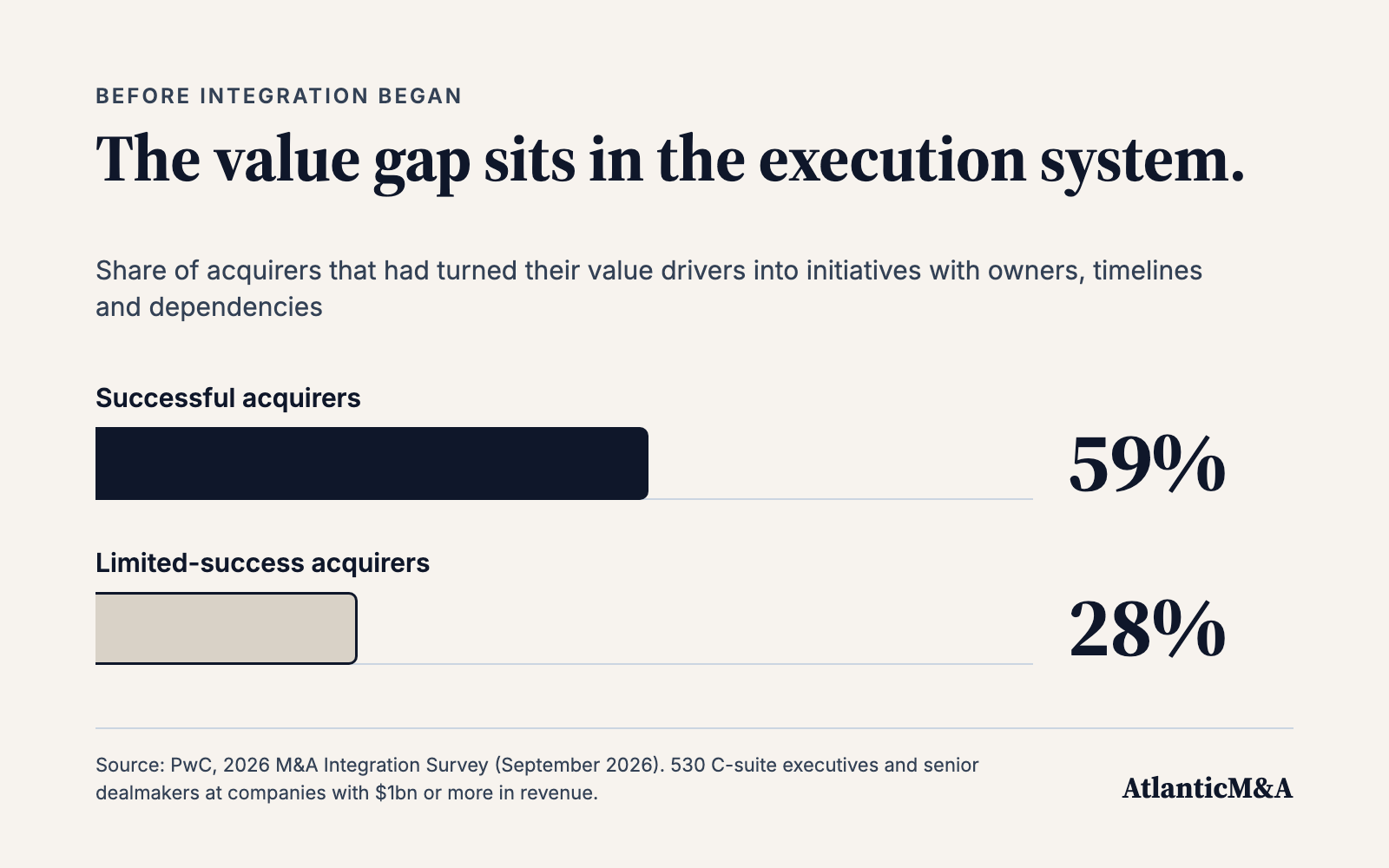
Before integration began, 59% of successful acquirers had turned their value drivers into initiatives with clear owners, timelines and dependencies. Among limited-success acquirers it was 28%. PwC calls this 31-point gap the clearest signal in the survey that value creation depends less on the synergy case itself than on "the execution system used to realize it."
That is a strong statement from a firm that writes synergy cases. The plan matters less than the machinery that carries it.
Proof is the second half
Three in four respondents tie material incentives to synergy outcomes. Fewer than half are very confident that the synergies they report are real and auditable: 62% of successful acquirers, against 27% of limited-success ones. PwC's question for the board is whether it can tell realised value from forecast value, double counting and ordinary business performance.
The market seems to care. In a separate study of 180 US public deals worth $1 billion or more, announced between 2016 and 2024, PwC found that acquirers who announced synergies and then reported on them outperformed silent acquirers by roughly 40 percentage points in share price over three years. PwC is careful to call that correlation, not causation. It is still a reason to build the proof as you go, rather than reconstruct it for the annual report.
What the survey leaves open
The survey says what to decide. It says less about where those decisions live once they are made.
In most integrations I have seen, the thesis sits in a deck, the synergy case in a spreadsheet, the plan in a project tool and the status in slides rebuilt every week. Each is a copy, and the copies drift apart. PwC's own history shows the result: 59% of acquirers had a target operating model in place at signing in 2020, and 61% in 2023. PwC's own reading is that the market has plenty of frameworks but has not moved the decisions that matter any earlier.
I don't think another framework moves them. A system of work does: one place where the thesis, the value drivers, the workstreams, the tasks and the measured value stay connected, so a decision made before Day One is still visible, owned and measured on day 200.
How atlanticma.ai closes it
That is what I built atlanticma.ai to do.
- Strategic Direction is where the deal thesis becomes value drivers, objectives and proposed workstreams. You can write it yourself or give it a short brief and let the AI draft it. Nothing is written into the record until you accept it.
- Line of Sight traces each value driver and objective from the thesis through the charter's milestones into the work plan and the RAID log, and shows where that thread breaks. Owners, dates and dependencies sit on the work plan itself.
- Benefits track value against the approved baseline, with who entered each actual and when. The Deal Value bridge (an add-on in early access) shows the underwritten case, where you are now and what remains to be delivered.
- Meetings come back as proposed changes to items already in the plan and the RAID log, with new actions, decisions and risks listed alongside. A person accepts, edits or dismisses each one, and every accepted change is in the audit log.
PwC also says a single integration template cannot tell leaders what to prioritise. I agree. Start from a template for the structure, or have the AI build the plan from the deal's own brief and documents.
Own the context, don't rent it
There is one more reason to hold all of this in a system the company owns. Every integration builds up context: the thesis, the decisions and why they were made, the stakeholders, and the risks that came true and the ones that didn't. On an adviser-run programme that context lives in the adviser's files and people, and it leaves with them when the engagement ends. The next deal starts again, and the company pays to rebuild what it already learned.
I think a company should own its project context rather than rent it, project by project, from PwC. In atlanticma.ai the plan, the decisions, the meeting record and the value history stay with the company, and the method from the last integration becomes the template for the next. Advisers can still work in it: invite them to the account, free as read-only viewers or on a seat to edit. They just don't take it with them.
Where AI fits
PwC separates three roles for AI in a deal: an acquired capability, an integration accelerator, and a new operating model. Roughly three in four acquirers use AI somewhere in integration, but only one in five made building an AI-ready foundation a primary objective.
The accelerator is the role every acquirer can act on now. McKinsey estimated in September that agents can cut the time spent on many core transformation tasks by 35 to 40 percent. I think the question is where that time goes. Spent on the decisions and the proof PwC describes, it closes the gap. Spent on faster slides, it does not.
A note for the mid-market
PwC surveyed companies with $1 billion or more in revenue. Smaller acquirers face the same decisions with fewer people, and usually without an integration office. I think that makes the system matter more, not less.
If you want to see your next deal's thesis turned into owned, measured work, start the 14-day free trial (no card needed) or try the interactive demo.
About AtlanticM&A
AtlanticM&A is the Agentic Transformation OS. Its agents work inside the programme, both augmenting and automating the work of the transformation team: work plans, governance, stakeholders and reporting in one place, with a live value bridge that moves as the work does. It is a system of work rather than only being a system of record: the charter is written in it and the plan is built in it. Meeting notes come back as proposed updates to the plan and the RAID log, the team decides what stands, and every change the AI makes carries an audit trail. The platform does the slide-building, status reporting and stakeholder briefings that usually keep a consulting pyramid busy, so a small senior team can run the programme more nimbly and for less.