Can't I just do this in Claude? Why transformations fail between people
AtlanticM&A5 min read
Two questions come up more and more now that AI assistants are on every desk.
"Can't I just do this in Claude?"
"Couldn't I build my own version on a laptop over a few weekends?"
Both are fair. An AI assistant drafts a charter or a 100-day plan in seconds, and a capable person can point a local model at a folder of files. If producing documents were the job, the answer would be yes.
It is not the job.
Even one person needs more than an assistant
Even working alone, a general assistant waits for instructions. You decide what to ask, paste in what it needs, and copy its answer somewhere useful.
AtlanticM&A's transformation agents already know the job and get on with it. They read the programme as it changes: they capture what a meeting decided, propose the update to the plan or the risk log, draft the steps under a task and build the steering pack. You accept what they propose, or you do not.
But that is the smaller gap. The bigger one is between people.
Transformations fail between people
As Chief Transformation Officer at a PE-backed company, I integrated ten acquisitions in two years. Nothing failed inside one person's work. It failed between people.
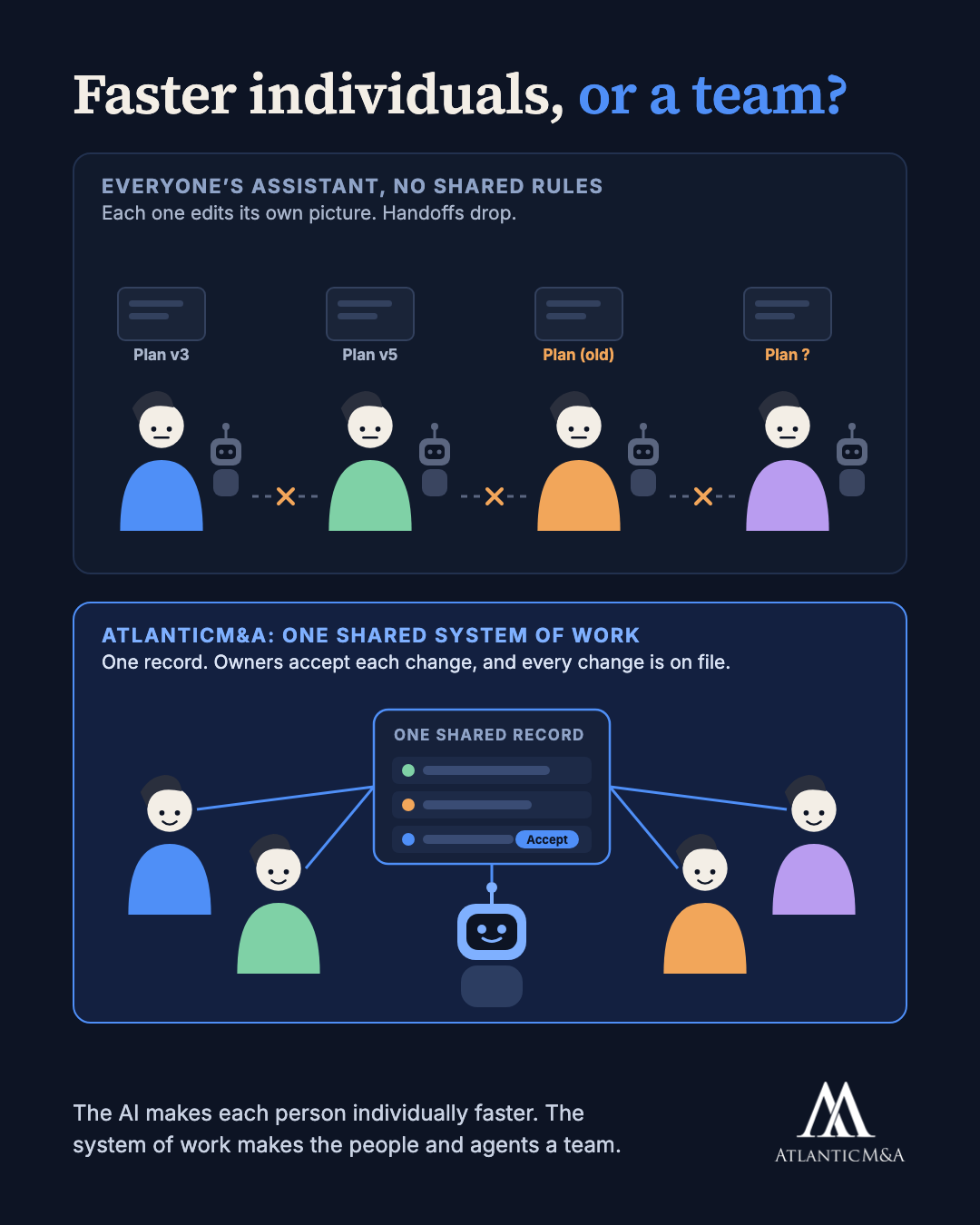
The realistic alternative today is not one person with an AI assistant. It is everyone on the team with their own assistant, plus shared folders and a general project tool. That feels coordinated. It is not.
- Handoffs still drop. The finance lead agrees a new date in a meeting; IT keeps planning against the old one, because the change lives in a transcript, not in the plan.
- Analysis is not systematic. Each assistant reads its own files and rebuilds its own picture of the programme, so ten people ask the same question and get ten answers.
- Decisions are made on different context. The sponsor, the workstream lead and the client are each looking at a different version of the truth.
- Nothing is repeatable. The playbook from the last deal lives in someone's chats and folders, so the next acquisition starts again from scratch. In a buy and build, that is the whole game.
- Nothing is auditable. When the board asks why a synergy target was cut, or who agreed to move Day 1, the answer is buried in a chat nobody else can open.
- The people side is guesswork. Each assistant knows only what its own user has told it about the CFO, so nobody can see how a decision will land across the leadership team before it is taken.
Why not connect every assistant to a shared plan?
You can. Then you need rules: what a risk or a dependency means, who can change what, which changes need sign-off, and how a moved date flows through to the tasks, the TSA exits and the synergies that depend on it.
Each of those rules sounds simple. Together they are a product. Nobody runs a company's books in a spreadsheet their assistant edits. They use a ledger, because double entry, approval limits and an audit trail are what make the numbers trustworthy. A transformation needs the same.
One shared model of the programme
That is what AtlanticM&A is. It holds one shared model of the programme: the documents, the plan, the risks, the stakeholders, the TSA services and the synergies, connected to each other.
The team does the work in it. Charters are written there, the plan is built there and delivery is recorded as it happens.
A change raised in a meeting or proposed by an agent waits for its owner to accept it, with a history of who changed what and why. Then everyone sees the same thing.
The board pack is built from that record, so the steering committee decides on the same facts as the team.
Because every meeting and signal lands in the same record, AtlanticM&A keeps a living persona for each key stakeholder, and can model how a decision is likely to move through the leadership team before it is taken. The modelling is in beta.
And when the next deal arrives, the last integration is copied as the starting point for the new one, so every acquisition runs the same way.
Why this matters more as AI improves
Teams are getting smaller, and more of the work is done by agents. That does not make coordination less important. With fewer people and more agents, coordination is the job.
None of this is a case against AI assistants. Claude is brilliant at drafting, and AtlanticM&A's connector lets it read the project too, so the assistant someone already uses can answer from the shared record rather than from whatever they pasted in. The connector is in beta.
The AI makes each person individually faster. The system of work makes the people and agents a team.
If you are weighing the do-it-yourself routes, we set them out side by side, cost included, on the Agentic Transformation OS page.