The transformation office does not need better reporting
AtlanticM&A8 min read
It needs a system of work the client owns. A response to McKinsey's September 2026 article, The agentic transformation office: Redefining the economics of change, by Chase Covington, David Pralong and Tomer Slaney.
Where we agree
McKinsey is right about the diagnosis. Traditional transformation offices are too large, too manual and too late. The function charged with making the organisation faster is often the slowest part of it.
The article is precise about what is broken:
- Manual tracking consumes the centre. In one turnaround, more than 15 people spent over half their time validating data for a 300-page monthly pack.
- Data fragments. Workstreams build shadow trackers; one programme ran on more than 100 non-integrated documents.
- Insight arrives after the decision window, so leadership meetings become firefighting.
- Narrative drifts, because each workstream tells a slightly different version of the same story.
- Human judgment is still needed for escalations, stakeholders and culture, and that is the capacity the admin crowds out.
Its remedy is to automate the centre. Agents synthesise performance, keep a single source of truth and draft the SteerCo materials, so a team of ten becomes a team of three. That is a real improvement. It is not the whole answer.
Three gaps in the agentic TO
McKinsey's three pillars, performance intelligence, a single source of truth and conversation facilitation, make the office faster at what it already produces: status, exceptions, briefings and decks. The office is still the system. That leaves three gaps.
1. A better reporting layer is not a system of work. The single source of truth links systems so the centre sees a cleaner picture. It is not where the work is accepted, sequenced and owned. The artefacts improve; the work still happens somewhere else, and someone still has to reconcile the two.
2. The users are still the centre. The article's people are engagement managers, analysts and central staff. The sponsor, the workstream leads, the interim directors and the target's own managers receive what the centre produces. They do not work in a shared system, so the centre remains the bottleneck it was meant to remove.
3. The system is rented from one firm. The agents run on Wave and Lilli, McKinsey's stack. A client can keep using Wave after the engagement, but it keeps renting a system built around one firm's method. And most large programmes are not one firm: an integration lead, an IT partner, a change specialist, legal and finance advisers all work the same plan. When each firm optimises its own stack, the client becomes the integration point. Automating one firm's office makes that firm more efficient; it does not make the programme easier to run.
Automating a central office is cheaper than staffing one. It is still a central office, and it still belongs to someone other than the client.
The programme outlasts the engagement
A transformation is not the length of the consulting contract. Integration may run 12 to 18 months. The earnout, the synergy realisation and the value creation plan often run three to five years.
Whoever owns the system that holds that plan decides what happens when the advisers leave. If the plan, its history and the cadence live in the firm's environment, the client inherits decks, a handover pack, and the option to keep renting. Each improvement to the firm's tooling makes the next engagement more natural and the exit more expensive.
The alternative is for the client to own the system of work from day one. The plan of record, its history, the accepted decisions and the cadence are the company's. Advisers are invited onto it for as long as they are needed and removed when they are not. The firm stays because it is good, not because leaving is expensive.
What a system of work looks like
An agentic transformation OS is the system a programme runs on, not a tool the centre reports from. It has four layers: what arrives (meeting transcripts, documents, data uploads, email); the records the team keeps (the work plan, RAID log, decisions, synergy claims, stakeholder map); agents that read those records and propose changes to them; and what leadership sees, from the board deck to the SteerCo pack, generated from the records rather than assembled by hand. Every party works in the records. The outputs are projections of them.
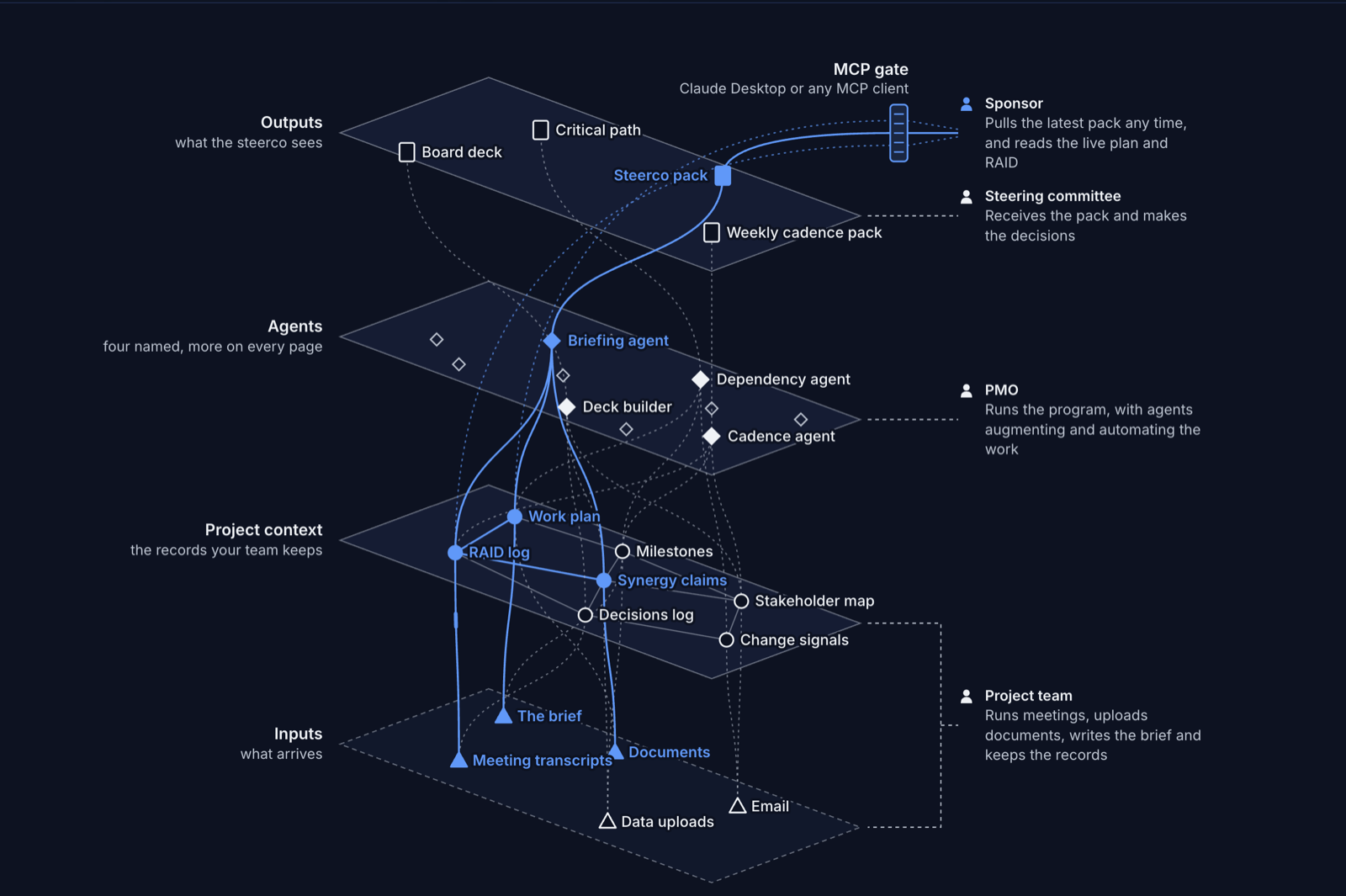
Meetings and documents update the records; agents propose; the SteerCo pack is generated from the plan, and sponsors can pull it through their own AI assistant.
AtlanticM&A is built on a different premise: the plan of record is the system, and decks are projections of it. The people doing the work, from every party, work in the same plan. Integration, divestiture, value creation, transformation, agentic transformation and cloud migration run on one backbone, with the domain tools workstreams actually use, such as TSA tracking, synergy modelling and value creation.
The question every transformation leader will ask is how the plan stays current without an army at the centre. The answer is that it is updated by the meetings people already hold. One illustrative week:
- Tuesday, SteerCo. A notetaker joins the call, or the transcript is uploaded afterwards. From the discussion it proposes the changes to the plan: a milestone moves two weeks, a new risk, a decision and who made it, three actions with owners.
- Tuesday afternoon. Each proposal waits as a suggestion until someone on the team accepts or dismisses it. Accepting the date change proposes the knock-on dates for the parent task and the milestone, each as its own suggestion.
- Wednesday. Every accepted change is in the plan's history, naming the meeting it came from. Workstream leads, the client's managers and the advisers see the same plan, the same risks and the same owners.
- Thursday, workstream review. The pack is refreshed from the live plan and sent to attendees about five minutes before the meeting. Nobody assembled it, and it cannot tell a different story from the plan it was generated from.
The centre shrinks because the work is already in the system, not because agents write the centre's slides faster. The parties can use their own AI assistants on the same plan, and the plan transfers to the client when the advisers' role ends.
Their guardrails, answered
The article is candid about the risks. Connected agents can turn one data error into a chain of bad decisions, they raise false alarms, and every step they take must be transparent and trackable. Its closing warning is that teams who do not trust the system fall back on manual habits.
A system of work answers that by design rather than by policy:
- Agents propose; people decide. A change the AI finds is a suggestion until someone on the team accepts it. A false alarm costs one dismissal, not a wrong number in the board pack.
- Every change is traceable. Each accepted change records who accepted it, when, and which meeting it came from, and recent automatic changes can be undone.
- Automation is earned, not assumed. Applying suggestions automatically is off by default and switched on one type at a time, per project. Judgments about people, such as a stakeholder's support for the deal, are never applied automatically.
- Trust follows ownership. Workstream leads trust the plan because it is theirs: they accepted what is in it. That is the adoption problem the article ends on, solved by who uses the system rather than by change management in the centre.
Stop renting the transformation
McKinsey correctly identifies that human bandwidth is the constraint and that predictable data work should be automated. Its conclusion is a leaner central office that produces better artefacts, still built on their stack.
The better conclusion is that the artefacts were never the system. Once the plan of record is the shared system of work, the central office becomes small because it is no longer the bottleneck. Insight is current because meetings update the plan. Narrative does not drift because there is only one plan. Every party's contribution is visible against it. Judgment has room because the admin is no longer the job.
And when the engagement ends, the system, its history and its cadence stay with the people who own the outcome. Companies can stop renting their transformation and own the system it runs on.
About AtlanticM&A
AtlanticM&A is the Agentic Transformation OS. Its agents work inside the programme, both augmenting and automating the work of the transformation team: work plans, governance, stakeholders and reporting in one place, with a live value bridge that moves as the work does. It is a system of work rather than only being a system of record: the charter is written in it and the plan is built in it. Meeting notes come back as proposed updates to the plan and the RAID log, the team decides what stands, and every change the AI makes carries an audit trail. The platform does the slide-building, status reporting and stakeholder briefings that usually keep a consulting pyramid busy, so a small senior team can run the programme more nimbly and for less.